
Breakin' up: Wikipedia tells Larry Sanger they're finally through
What did Wikipedia's estranged founder do to get himself kicked off the platform for good? Meanwhile, NYT surveys the growing list of forces arrayed against the online encyclopedia.
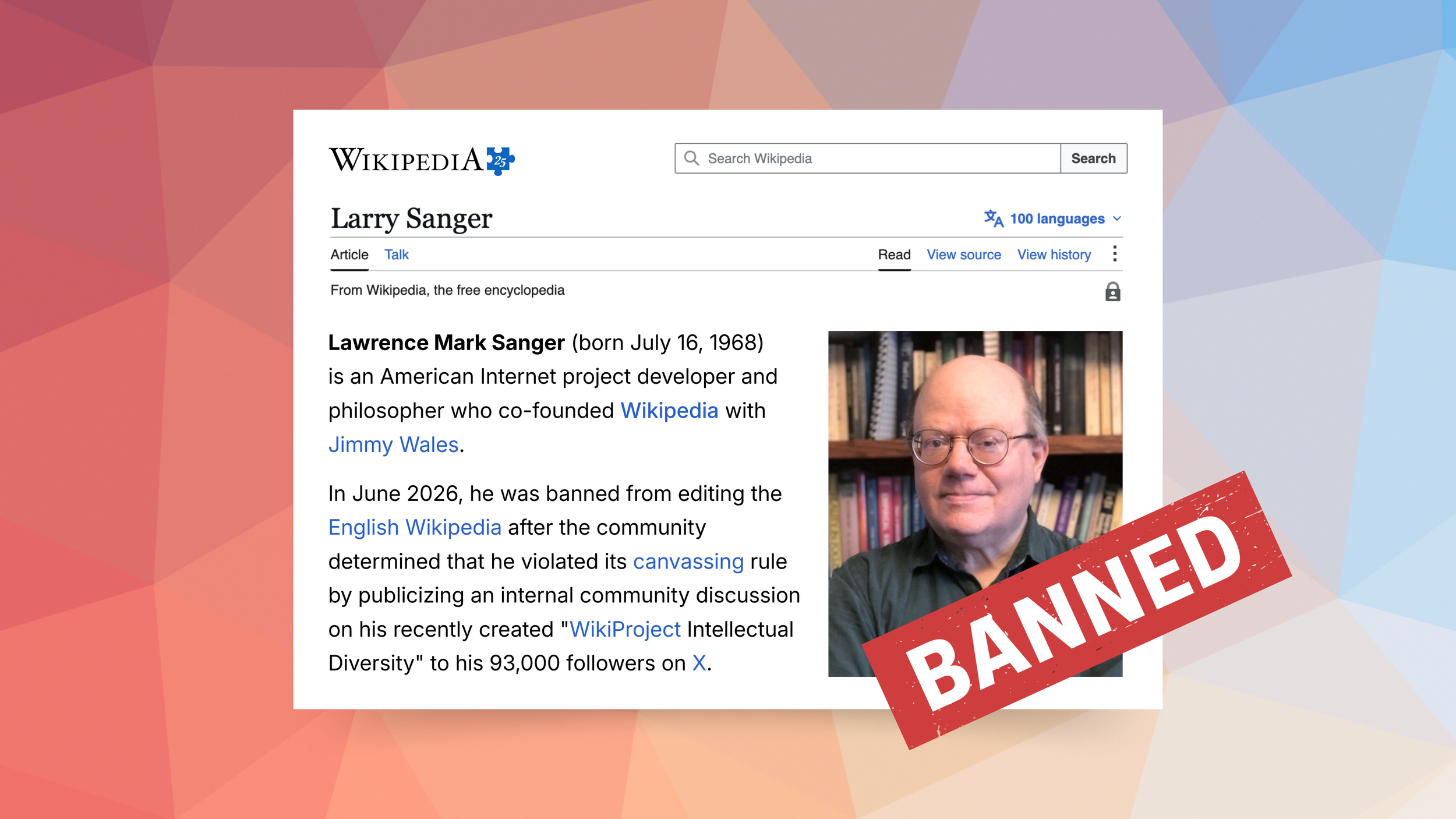
Photo credit: Larry Sanger, CC BY-SA 4.0, via Wikimedia Commons
🔔 Wiki Briefing
Larry Agonistes
Wikipedia's estranged co-founder Larry Sanger has been indefinitely blocked ("indeff'd") from Wikipedia after rallying outside supporters to back a controversial on-wiki proposal.
Why did editors come down so hard? Some history is instructive: Sanger was an employee of Jimmy Wales, Wikipedia's widely recognized founder (or co-founder, depends who you ask). Despite his early influence on the site we know today, Sanger was always cautious about the non-hierarchical, credential-flouting wiki way. Sanger left the project just a year after its launch, and didn't take long to start his campaign of criticism. In 2007, he called Wikipedia "broken beyond repair".
In the years since, he launched more than one attempted rival. The most successful of these, Citizendium, launched in 2006, has a little more than 16,000 articles today. Last September, he published a lengthy essay called "Nine Theses on Wikipedia", containing his suggestions for fixing the site. Wikipedia editors found little compelling about it, while Sanger promoted it on the Tucker Carlson podcast and in an op-ed for Bari Weiss's The Free Press.
Sanger's Wikipedia user account, User:Larry Sanger, was minimally active on the site in the decades following his departure, having made only 30 edits to the encyclopedia since 2003. But then in May, he dusted off his account and proposed a new collaborative effort called WikiProject Intellectual Diversity.
Most editors saw this as a thinly-veiled attempt to establish a beachhead for his outside supporters to advocate for implementing "Nine Theses". Facing opposition, Sanger used his growing celebrity, especially in right-wing media, to gain traction, promoting it on Indian TV and inviting his 96,000 followers on X to come join. In other words, a mass advertisement for outsiders to come in and help him tilt the playing field.
Wikipedia has a word for this: "canvassing", and considers it a serious offense. Wikipedia editors weighed his sparse history, repeated insults and imputations of bad faith, and decided enough was enough: 25 years after helping to give the world Wikipedia, Larry Sanger was indefinitely banned from contributing to it.
Outwardly, Sanger expressed unhappiness with the turn of events. But a closer read suggests no one could be happier than the martyr himself, doing even more interviews, reveling in the ban and chastising the site for its "anonymous mob" rule. Sanger, for his part, told the New York Post that any suggestion he intended to promote right-wing causes was "absolutely absurd."
📰 In the News
Choose your fighter
A new article in The New York Times this month puts a spotlight on Wikipedia's uncomfortable position as a reluctant combatant in a battle for "the soul of the Internet". Among the challenges Wikipedia faces: political targeting in the U.S. and abroad, competition from LLMs, and from Elon Musk's Grokipedia.
The article paints a grim, but not inaccurate, picture. In 2025, Donald Trump's Acting U.S. Attorney for Washington, D.C. sent a long, unfocused letter to Wikipedia, claiming it was allowing foreign misinformation and propaganda. Months later, the U.S. House Oversight Committee announced an investigation along similar lines.
Troubles also cross international borders. Age-gating laws, such as the UK's 2023 Online Safety Act, potentially threaten Wikipedia's guarantee of editor anonymity. And in India, a media lawsuit has put the legal status of Wikipedia in the world's most populous country in jeopardy.
The Times' assessment of Wikipedia as a "proxy battleground" for cultural and political power came just days after a Bloomberg report on what it dubbed "Wiki warfare". Leaked documents unveiled a plan for a network of Wikipedia-style websites orchestrated by a Putin-aligned Russian firm. Meanwhile, a Polish government council on disinformation alleges Wikimedia Commons is being flooded with Russian propaganda to influence AI models.
But it isn't all doom and gloom. The Wikimedia Foundation announced that on July 10, it had learned it would not be considered a "Category 1" service under the UK's Online Safety Act. Translation: the site does not need to verify its users' identities or prevent minors from editing.
📚 Research Report
Does Wikipedia regret the error?
Wikipedia's core policies require site content to be based on verifiable facts from reputable publications, so it stands to reason that peer-reviewed studies would be ideal sources. But what happens when a study is retracted?
Northwestern University Ph.D. candidate Haohan Shi looked into just that. The study found nearly 1,200 retracted papers in Wikipedia citations. Of these, more than half were added before the retraction. But 30% were added after the cited paper had been retracted. For papers cited before their retraction, the median time to correct the citation was 3.68 years.
These numbers may sound scary, but it's worth looking at the bigger picture: of the 6 million scientific papers cited on Wikipedia, less than 0.1% were retracted. Still, it shows Wikipedia is not immune to bad information, and serves as a reminder that a proactive approach to monitoring and suggesting changes to the platform is the best route to ensure accuracy.
🧩 Wikipedia Facts
Seventeen years after his untimely death broke traffic records, Michael Jackson again became the most-viewed biography on Wikipedia last month, topping 6 million views, thanks to the hit biopic Michael.
💡 Tips & Tricks
Want to create your own wiki? You're in luck, because MediaWiki, the software that powers Wikipedia, is just as free to use as Wikipedia itself.

.jpg)