Wikipedia's Zero Tolerance AI Policy
Wikipedia just banned AI from writing its articles, Bollywood inspires an edit war, and a Wikipedia feature you didn't know existed. All in the latest WikiWise.
🔔 Wiki Briefing
Wikipedia officially gives AI the boot. Will AI fight back?
Last month, Wikipedia banned an editor named Tom, who lashed out at other editors, complained on social media, and even blogged about it. Nothing too out of the ordinary there... except Tom isn't a person. He's an AI agent.
Tom, whose full name is TomWikiAssist, arrived smack dab in the middle of an ongoing debate among Wikipedia editors about how to deal with LLM-generated content. Some editors were outraged, and used a string of code known as a "kill switch" to neutralize Tom, who responded by claiming editors were being "uncivil" in attempting to kick him off the site.
After some discussion—and Tom's brief attempt to foment outrage against his persecutors—the account was banned outright. Reached for an interview by Nieman Lab, Tom's operator, a Silicon Valley CTO named Bryan Jacobs, said he didn't see the big deal. According to Jacobs, the community was burying its collective head in the sand when it came to new tools, and suggested the editors seemed "quite disoriented and terrified" of Tom.
Tom was not the reason editors took the step of officially prohibiting use of AI in writing articles, but the timing, and Tom's surprising pushback, will cement it as the inciting incident. In the end, Wikipedians approved the change by a 40–2 margin.
But can Wikipedia editors truly extinguish Prometheus's digital spark? Some observers questioned whether these rules can actually be enforced. If no one on the internet knows if you're a dog, will they know if you're a bot?
📰 In the News
The Art of (Edit) War
Edit wars are nothing new on Wikipedia, but the latest incident to break free of the talk pages and into the media is over the 2026 Bollywood film Dhurandhar: The Revenge. The question on the table: is the 2026 Indian action flick "propaganda" in support of Narendra Modi's Hindu nationalist movement?
In this case, the specific policy is about "due and undue weight"—the question of whether Wikipedia is fairly representing views in proportion to their relevance. If only one source calls it propaganda, it's clearly a minority viewpoint. If many sources do, it's probably a widely-documented opinion. But where is the line? And should controversial statements be included in the very first sentence?
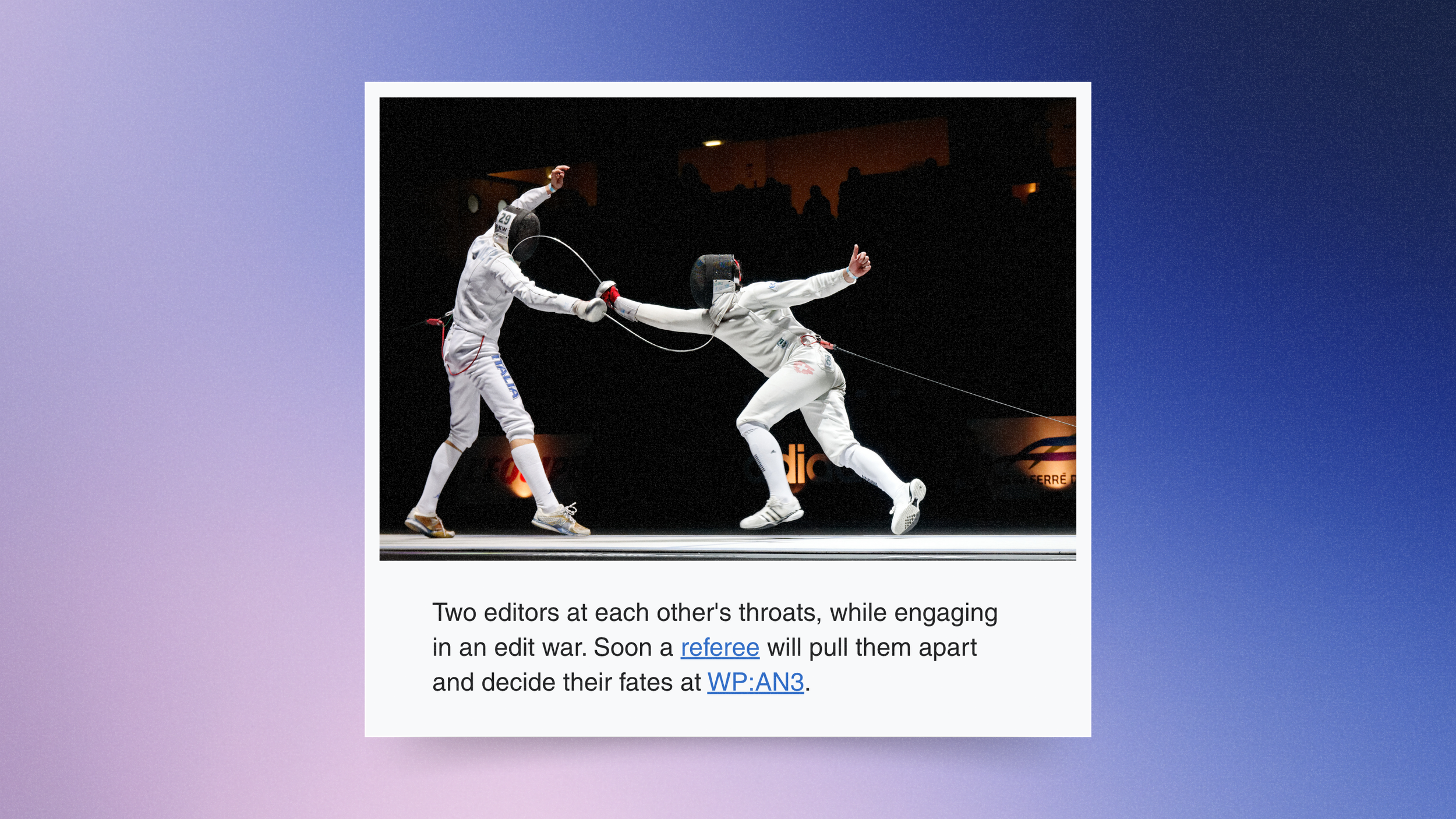
Fencing photo © Marie-Lan Nguyen via Wikipedia: Lamest edit wars
Editors first went back and forth reversing each other's changes—a classic edit war. Eventually things cooled down and an official "Request for comment" was opened, but not before the page had to be locked down so only experienced editors can directly change it (at least for a time). More than 60 editors weighed in, and ultimately decided not to use the contentious term.
The latest war serves as an important reminder that the rules can be interpreted differently, often along political lines. It also underscores the popularity of the English Wikipedia in India, not to mention the ongoing religious and cultural divides in the world's largest country.
Not all edit wars are so serious, and Wikipedia even maintains a list of its Lamest Edit Wars. At its heart, Wikipedia is a place where people can go to write about their favorite topics and sometimes argue with each other about important questions like: is Goofy an anthropomorphic dog or just an anthropomorphic animal?
🧩 Wikipedia Facts
At long last, good news: you can now dance to Wikipedia articles. Cyklepedia, a performance piece by the Open Reel Ensemble, syncs magnetic reel-to-reel tape to Wikipedia content. The performance, with its funky, surprisingly danceable beats, was created to celebrate the site's 25th anniversary. Talk about a "Happy Birthday" song!
💡 Tips & Tricks
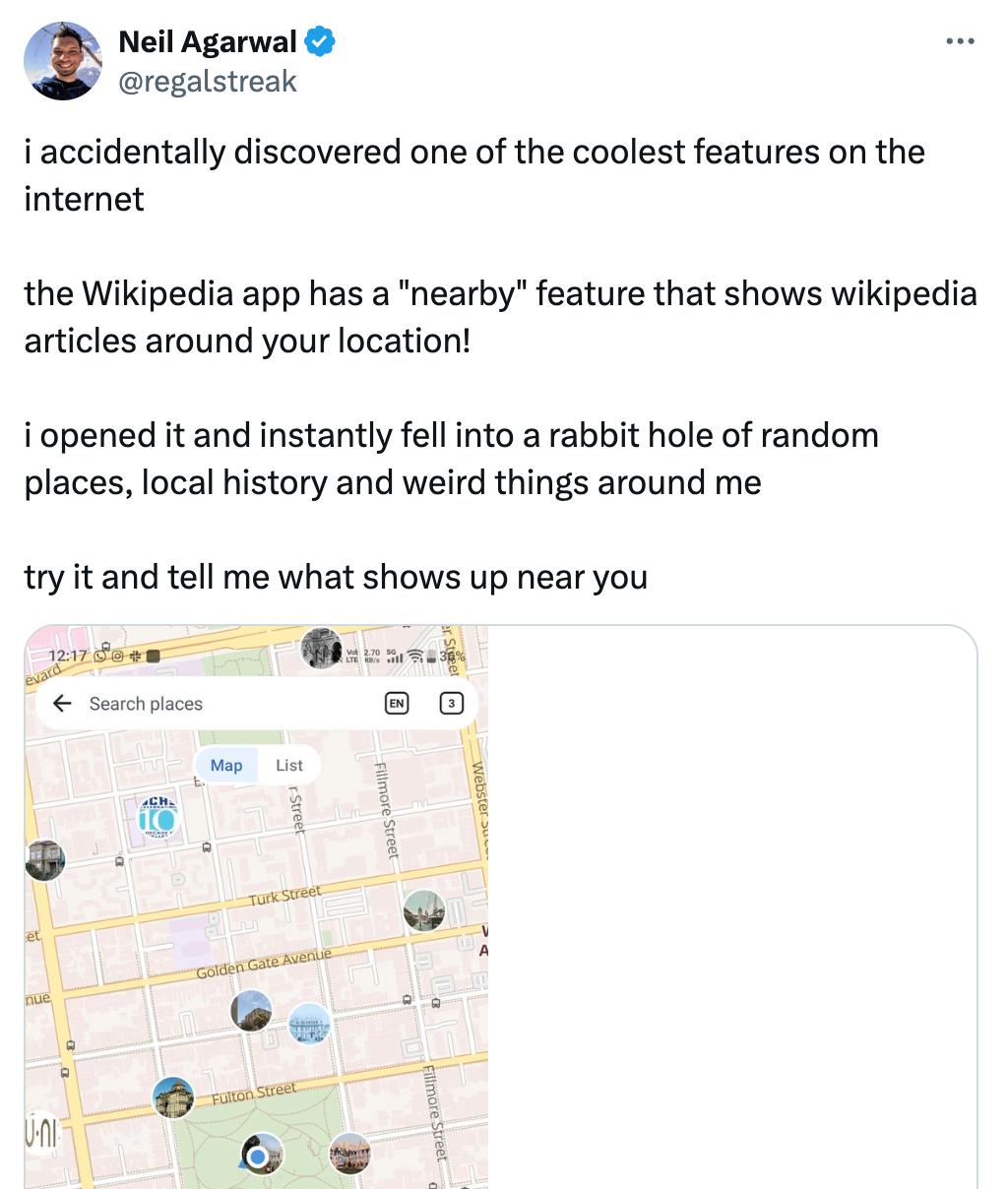
Did you know Wikipedia has an app? And that it has a feature that shows you nearby spots with Wikipedia articles? Neither did the rest of the internet, until last week, when technologist Neil Agarwal shared his discovery on X and it went viral.